
How Much Does It Cost To Remove Japanese Knotweed (UK – 2025)?
SUMMARY
Which Trade would normally do this: Gardener
Average time to remove Japanese Knotweed: 2 Days
Average cost to remove Japanese Knotweed: £2,000
- Material Costs 10%
- Labour Costs 70%
- Disposal Costs 20%
Introduction: How Much Does It Cost To Remove Japanese Knotweed?
Japanese Knotweed is a highly invasive plant that can cause you a lot of problems unless you get to grips with it quickly.
How much does it cost to remove Japanese Knotweed? Because it needs to be removed in its entirety, the job has to be done meticulously. It does depend on how much of it you have got, but on average it will cost you £2,000 to remove Japanese Knotweed.
There are however a number of factors to consider which we will cover in this article.

What Is Japanese Knotweed?
Japanese knotweed (Fallopia japonica) is a highly invasive plant species. It is native to East Asia, particularly Japan, China, and Korea, but has become a significant invasive problem in other parts of the world, including North America and Europe.
Key characteristics of Japanese knotweed include:
-
Rapid Growth: It is known for its rapid growth rate and can grow up to 10 cm per day during the growing season.
-
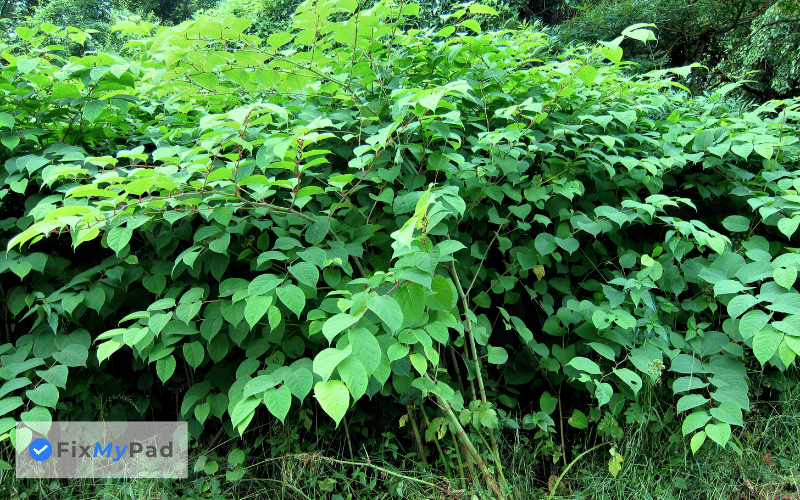
Appearance: The plant has bamboo-like stems that are hollow and can grow up to 2-3 meters tall. The leaves are broad, with a flat base, and are arranged in a zig-zag pattern along the stems.
-
Flowers: It produces small, creamy-white flowers during late summer and early autumn.
-
Root System: It has a deep and extensive root system (rhizomes) that can penetrate deep into the ground, making it difficult to eradicate.
-
Environmental Impact: Japanese knotweed can cause significant damage to building foundations, roads, and riverbanks due to its aggressive growth. It can also outcompete native vegetation, leading to a loss of biodiversity.
-
Control and Eradication: Controlling and eradicating Japanese knotweed is challenging. It often requires a combination of methods, including mechanical removal, chemical treatment, and in some cases, biological control.
-
Legal Implications: In many regions, there are legal implications associated with the presence of Japanese knotweed on property, as it can impact property values and may require professional removal.
Its resilience and ability to spread quickly make it a problematic species in areas where it has been introduced. Efforts to control and manage Japanese knotweed are ongoing in many countries to prevent its spread and mitigate its impact on ecosystems and human infrastructure.

How Do You Remove Japanese Knotweed In A Garden?
Getting rid of Japanese knotweed in a garden can be challenging due to its aggressive growth and deep root system. However, with persistence and the right approach, it can be managed and eventually eradicated. Here are some methods of removal:
- Mechanical Removal:
- Regularly cutting the stems can weaken the plant over time, but this method alone is unlikely to eradicate it.
- Digging out the roots (rhizomes) is more effective but very labour-intensive. It’s important to remove as much of the root system as possible, as even a small piece left in the soil can regrow.
- Chemical Treatment:
- Herbicides containing glyphosate are often effective against Japanese knotweed.
- Apply the herbicide to the leaves, stems, or inject it directly into the stems.
- Treatment should be repeated over several growing seasons for the best results.
- Always follow the manufacturer’s instructions and local regulations when using herbicides.
- Covering and Smothering:
- Covering the affected area with a heavy-duty weed barrier or tarp can help to smother the plant.
- This method requires time (usually a few growing seasons) and must be monitored to ensure the knotweed doesn’t find a way around the barrier.
- Professional Help:
- For severe infestations, it’s often best to seek professional help.
- Professionals have access to more potent herbicides and techniques that are not available to the general public.
- Disposal Considerations:
- Be careful when disposing of Japanese knotweed material, as it can easily spread.
- Never compost it or dispose of it with regular garden waste.
- Check local regulations for guidance on disposal.
- Monitoring and Persistence:
- After initial treatment, monitor the area regularly for regrowth.
- It often takes several years of consistent treatment to completely eradicate Japanese knotweed.
- Biological Control:
- In some regions, biological control methods are being explored, such as introducing natural predators of the plant. However, this is more common in large-scale infestations and ecological management, rather than in individual gardens.

How Much Does It Cost To Remove Japanese Knotweed?
As we have already seen this plant is not easy to remove. If you use a herbicide it will still take a number of years of treatment to be sure you have eradicated it. Often therefore physical removal of the plant and roots is often considered. This would then be followed by regular monitoring.
The herbicide option is the cheapest but has to be repeated. This clearly depends on the extent of the plant in your garden, but a rough figure of £1,200 should be expected.
The manual excavation is likely to be quicker and potentially more effective if done correctly. This is however time consuming and will be around £2,000 at least.
Get An Expert To Do The Work
Make sure you find a gardener who knows what they are doing and have experience of removing Japanese Knotweed. Get a few quotes so that you get a consensus of what needs doing in your situation.